Reusable solid core
A proposed four-segment steel motor case approximately 3.7 metres in diameter. The concept includes thrust-vector control for ascent and grid fins with parachutes for ocean recovery.
 STARSHOT AEROSPACEContact
 ALLSTAR-1 PROGRAMME / BLOCK 1 PRE-FEASIBILITY
AllStar-1 is a three-stage heavy-lift launch concept. The proposed vehicle combines a recoverable four-segment solid first stage, a wider solid second stage and a restartable cryogenic upper stage.
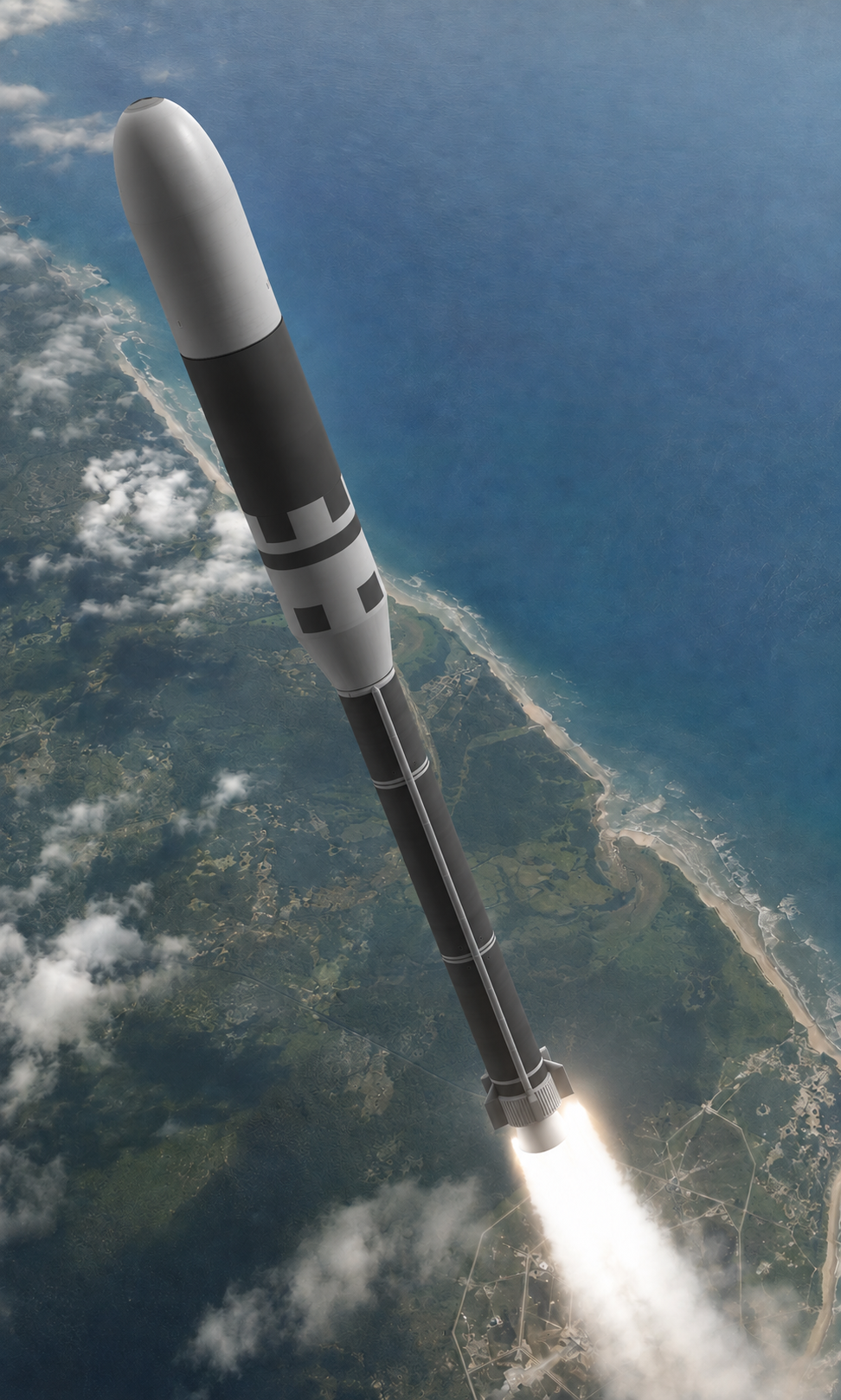
VEHICLE VISUALISATION
Three visualisations show the vehicle on the pad, lifting off and ascending above the site. The scenes use an illustrative LC-39B setting.
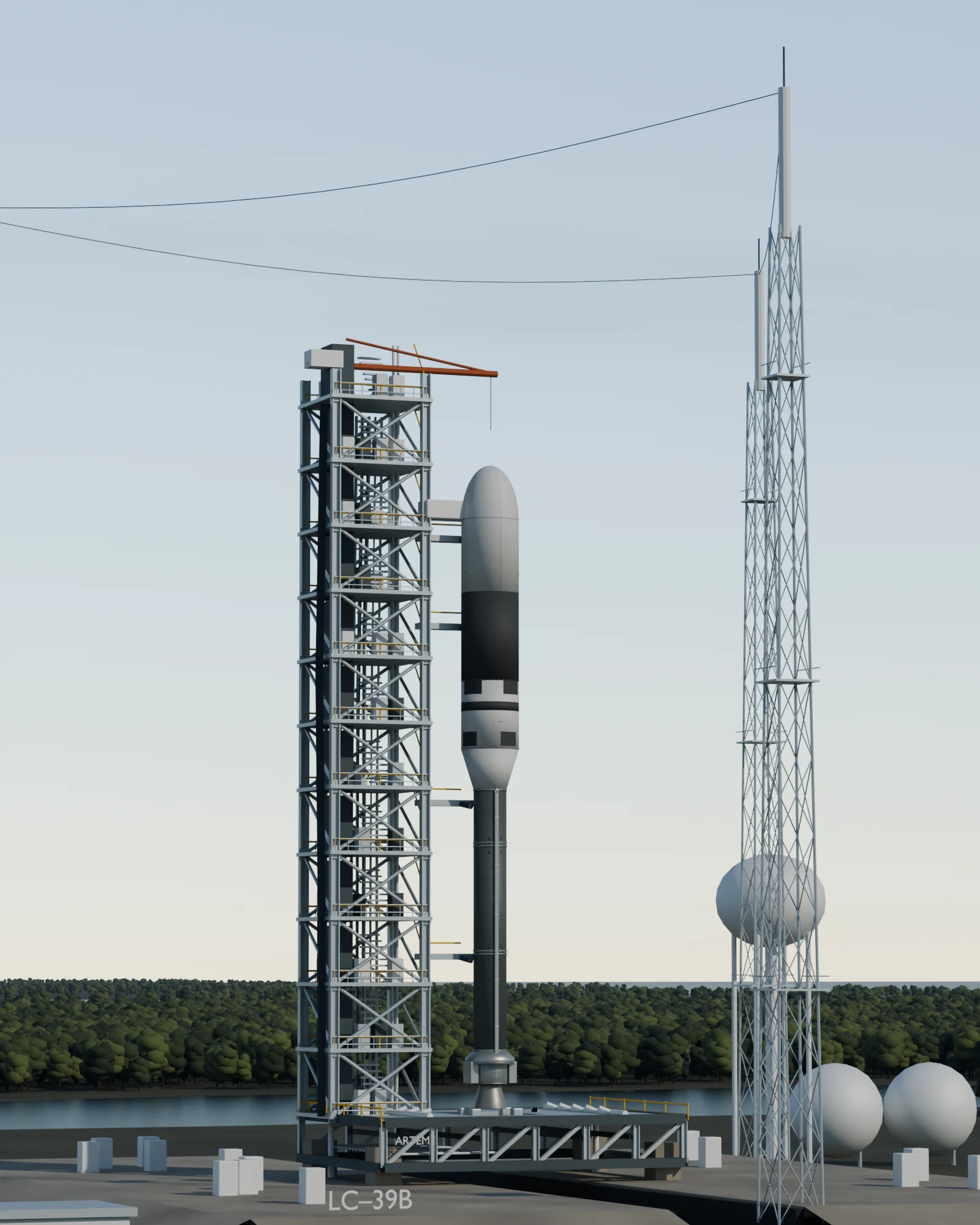
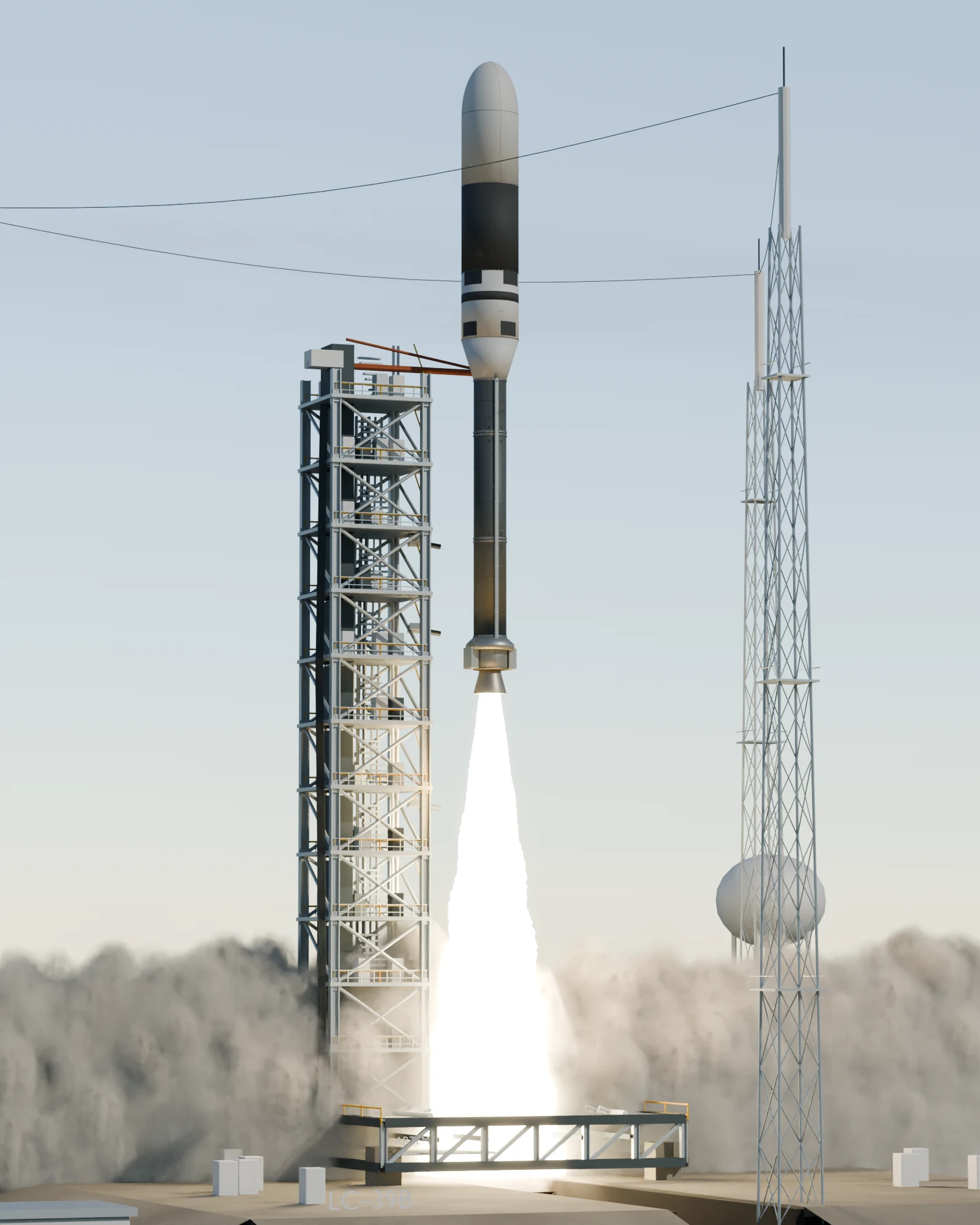
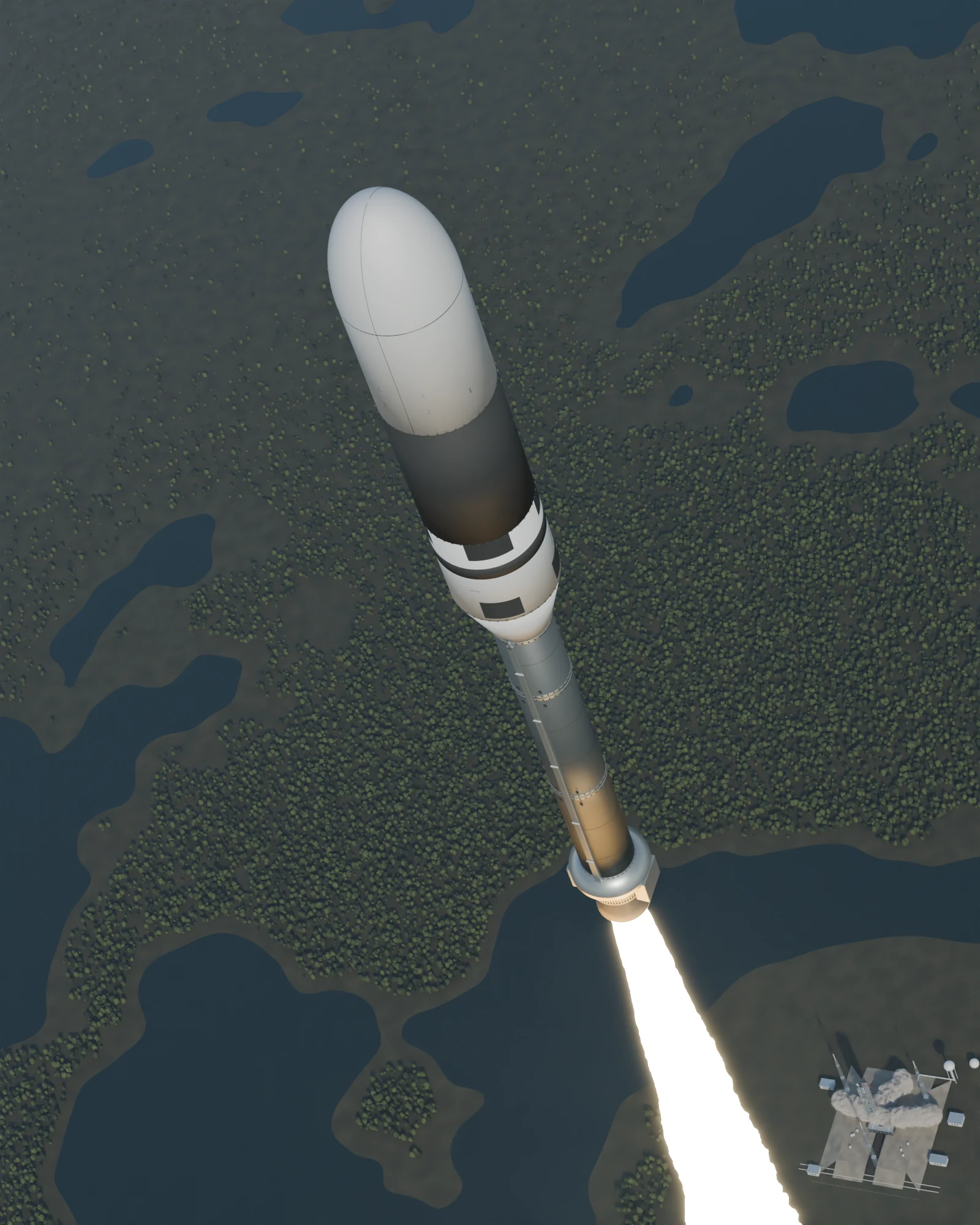
These are concept renders. The LC-39B setting is illustrative and separate from the Kourou site study below. The images do not establish a launch agreement or calculated flight trajectory.
THE CURRENT FINDING
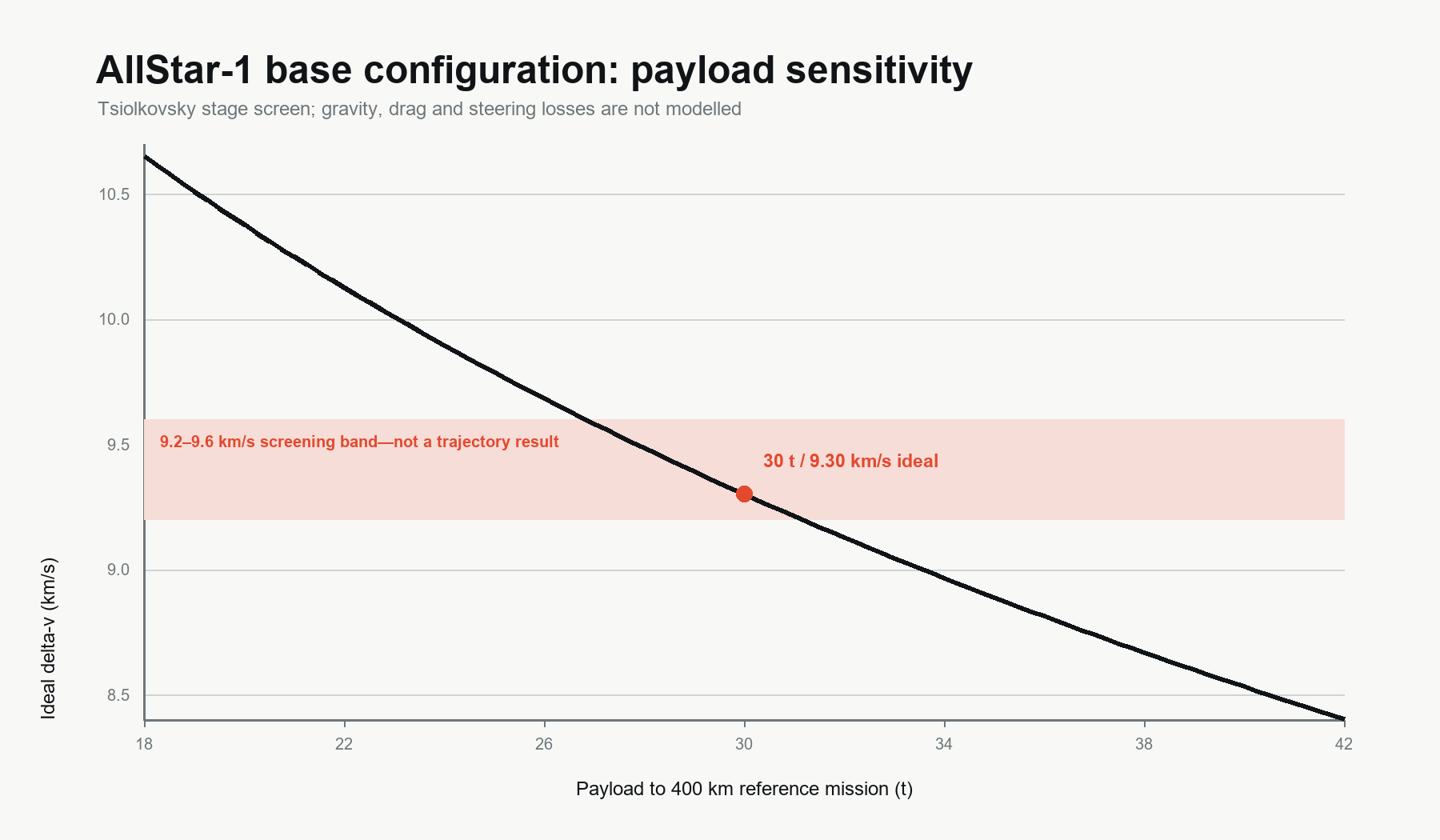
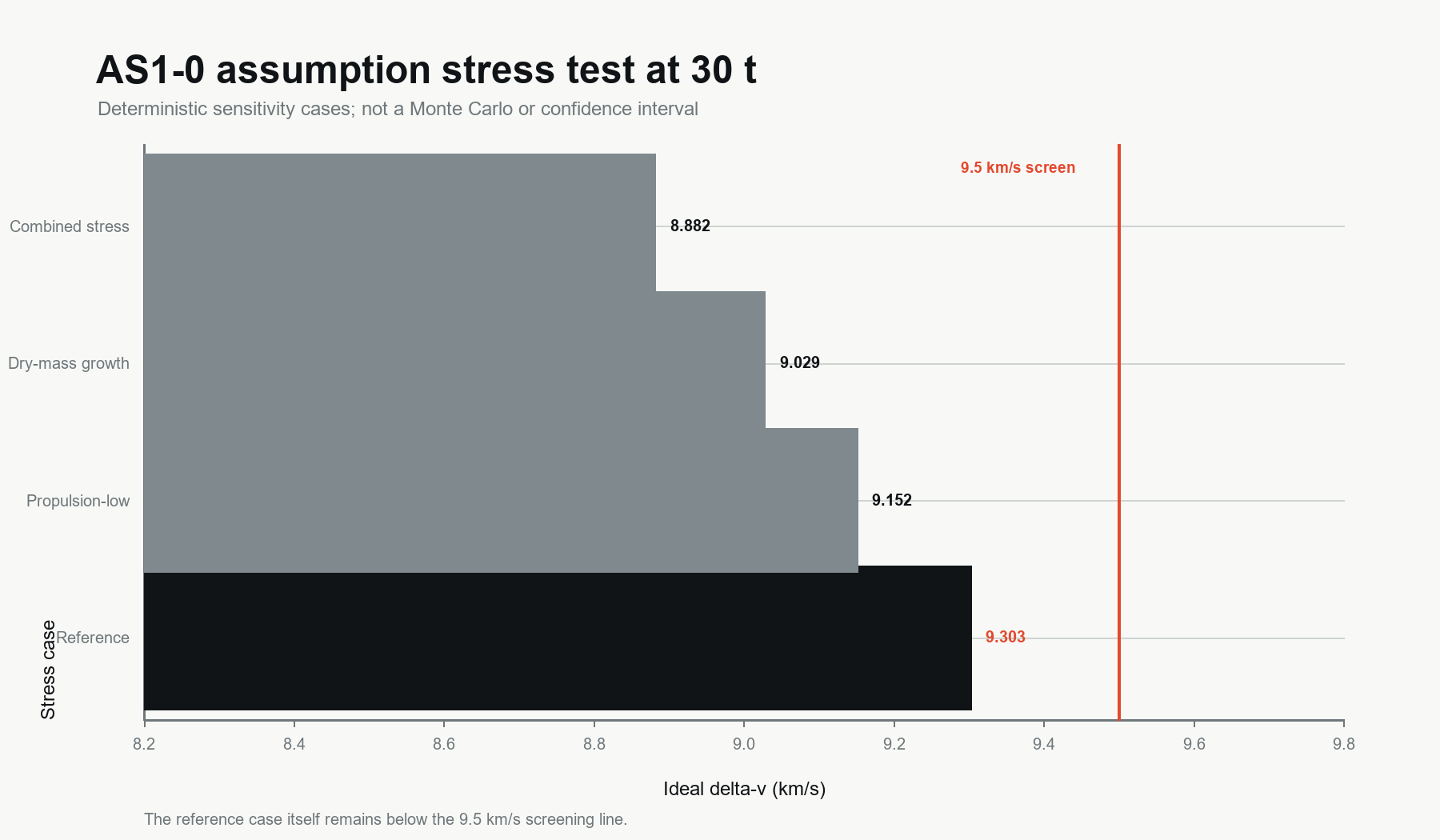
The preliminary mass model calculates 9.303 km/s of ideal delta-v with a 30-tonne payload. This ideal calculation alone cannot establish orbital payload capacity. It excludes gravity, drag and steering losses as well as operational margins. A case combining higher dry mass with lower propulsion performance gives 8.882 km/s before ascent losses are applied.
The next step is a detailed feasibility study. Payload capacity, launch price and operational suitability remain unconfirmed.
01 / REFERENCE STACK
AS1-0, AS1-3 and AS1-6 use zero, three and six additional boosters respectively. AS1-9 studies nine boosters with six ignited at launch and three ignited after the first set separates.
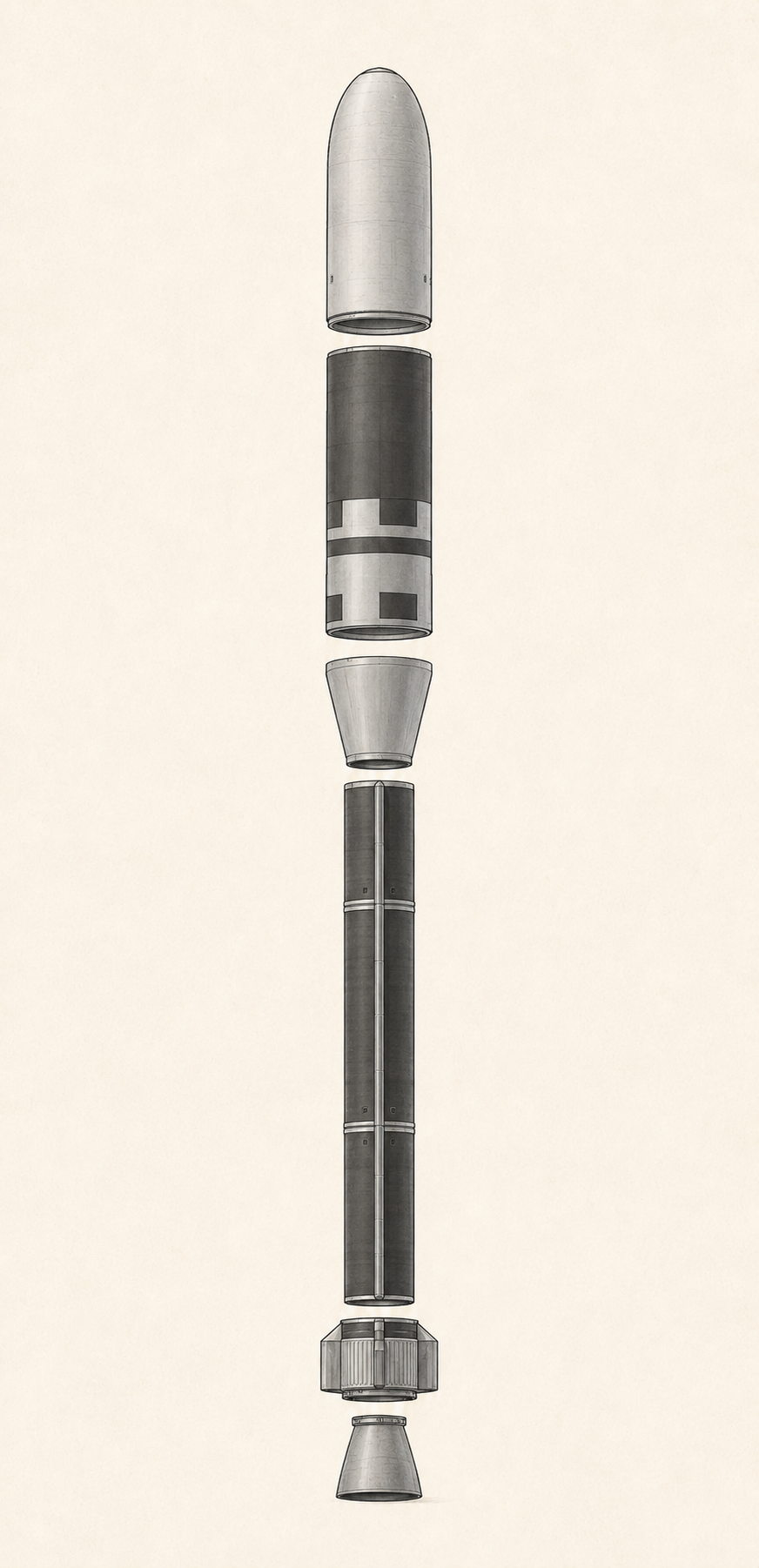
A proposed four-segment steel motor case approximately 3.7 metres in diameter. The concept includes thrust-vector control for ascent and grid fins with parachutes for ocean recovery.
A proposed 5.4-metre-diameter motor with 400 tonnes of propellant in the current model. This stage would require a new motor development programme.
The study considers Centaur V as a candidate cryogenic upper stage. Its two-engine RL10 configuration provides a reference for analysis. Supply, integration and export permissions would need to be established.
The model examines zero, three, six or nine GEM 63 boosters. The nine-booster case carries three unlit at launch and assumes an expendable first stage.
02 / PERFORMANCE SCREEN
For a 30-tonne payload, the model gives rounded ideal velocity changes of 1.442 km/s from the first stage, 3.826 km/s from the second stage and 4.036 km/s from the upper stage. The base case uses a liftoff mass of 1,140.9 tonnes and an initial thrust-to-weight ratio of 1.312.
02A / ASSUMPTION STRESS
The sensitivity study increases dry mass by 18% and reduces effective specific impulse. These assumed changes lower the ideal velocity result and show why the mass and propulsion estimates need further validation.
The cases compare selected assumptions. They are not statistical predictions or certified performance values.
03 / TANDEM BOOSTERS
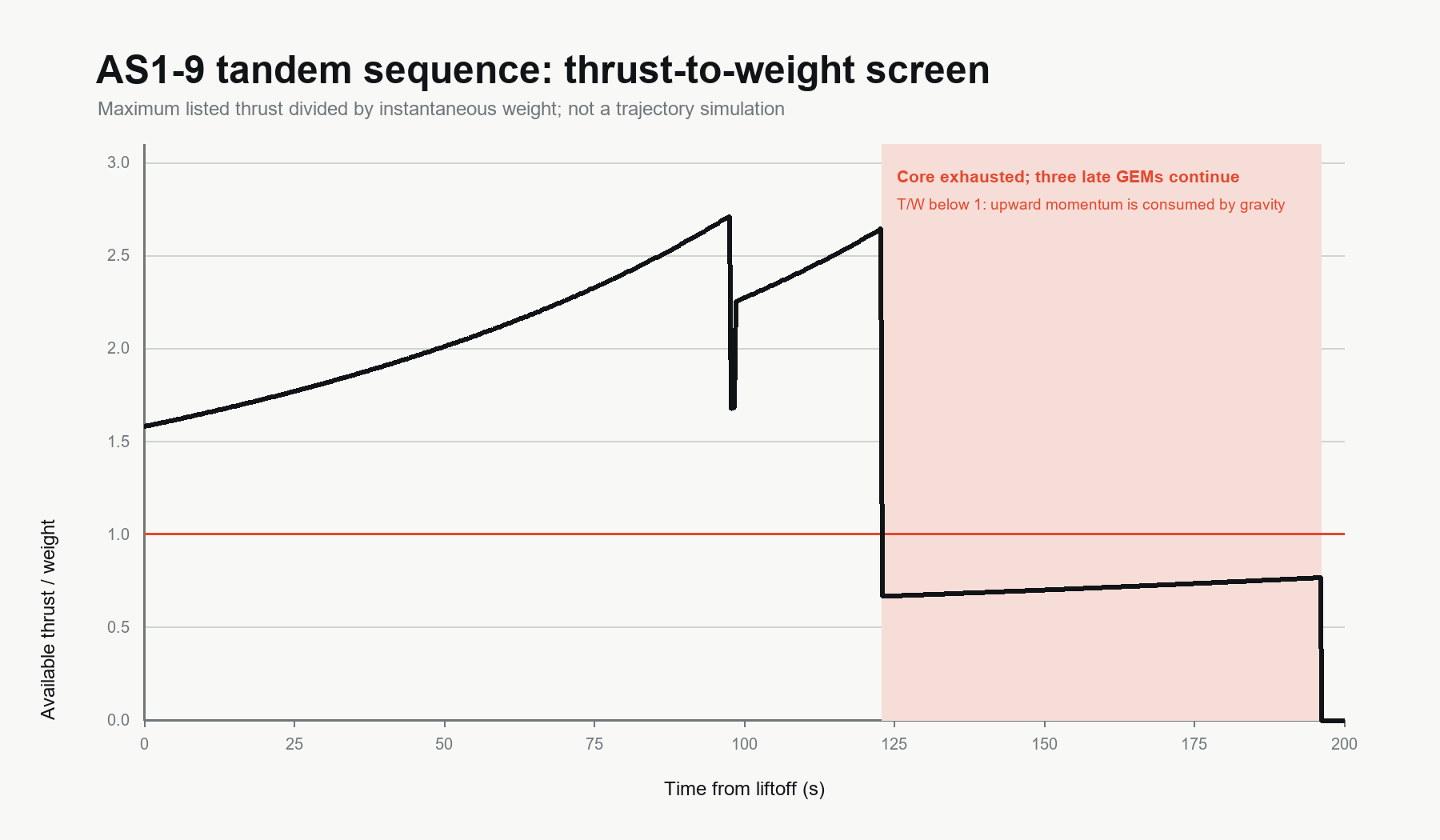
Six boosters ignite with the core at liftoff. After they burn out and separate, the remaining three ignite. The timings below are modelling assumptions that require separation and trajectory analysis.
T+0 Core and six GEM 63s ignite. Three are carried unlit.
T+97.6 s The first six burn out and separate.
T+98.6 s The remaining three ignite after an assumed clearance.
T+123 s The core burns out. Three GEMs continue while the empty core remains attached.
T+196.2 s The late set finishes and the wide second stage can take over.
The model gives a thrust-to-weight ratio below one after core burnout and before the late boosters finish. The effect on the flight path requires trajectory analysis. AS1-9 remains an unvalidated option.
04 / RECOVERY
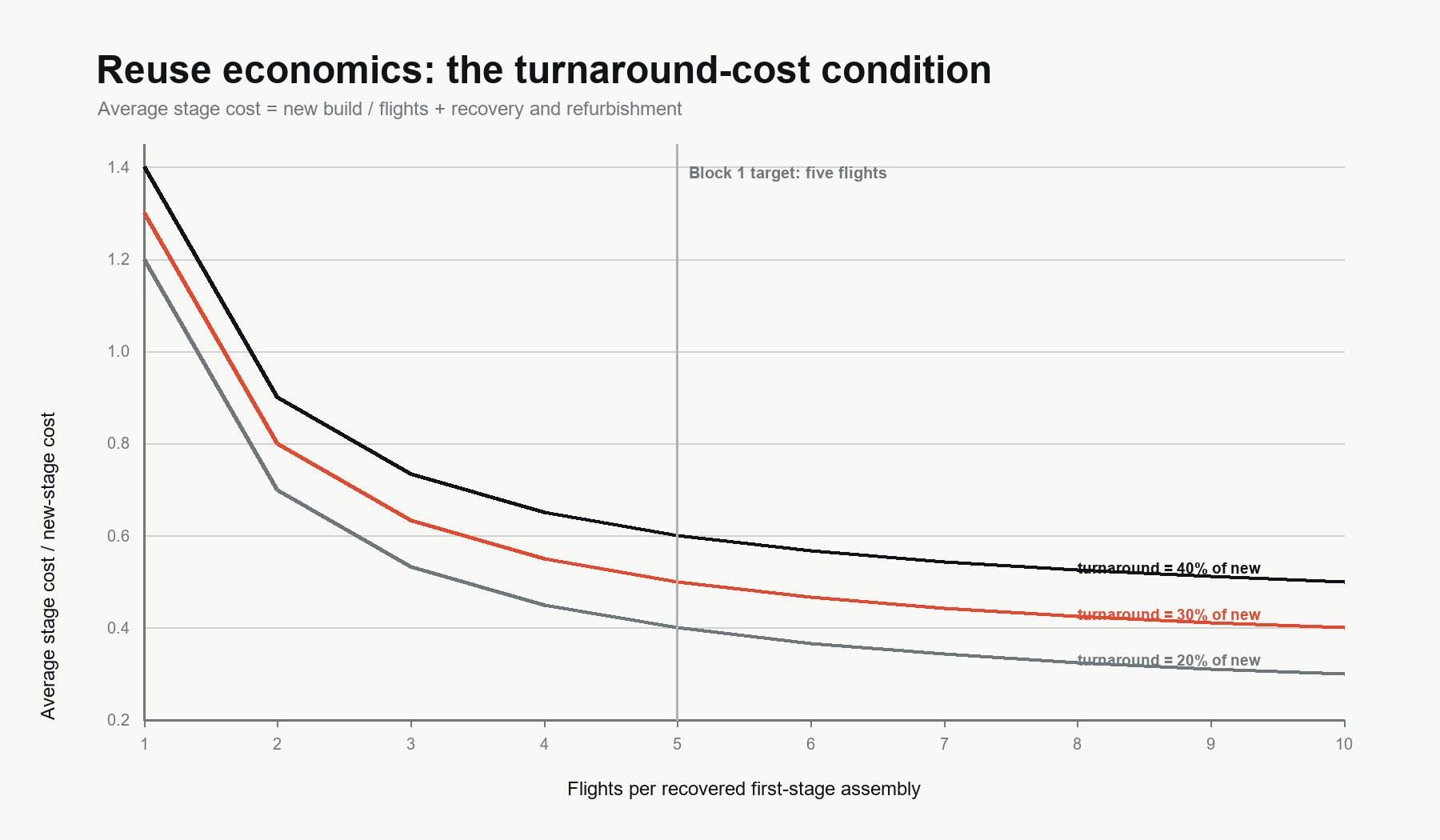
The Space Shuttle programme recovered and refurbished segmented solid boosters. AllStar-1 proposes grid fins for descent control and a target of five flights per core. The cost case depends on retrieval, inspection and refurbishment being cheaper than producing a replacement stage.
Grid fins would provide aerodynamic control during descent. Ascent would use thrust-vector control, including at liftoff when airflow provides little aerodynamic control.
05 / KOUROU
Kourou is a candidate location in the study. AllStar-1 would need compatible integration facilities, a suitable launch pad and an approved operating plan. Its modelled liftoff mass of approximately 1,141–1,585 tonnes rules out assuming that existing Ariane infrastructure could be used without major assessment and modification.
Assessment with the CAA of the Outer Space Act requirements for a UK operator launching or procuring a launch overseas.
Assessment of applicable French authorisations, technical requirements and environmental approvals.
Agreements for launch facilities, range services and vehicle integration. Plans would also cover propellant handling and maritime recovery.
Supplier agreements and applicable export permissions for US hardware and technical data.
06 / MISSION MARKET
The study considers government payloads, rideshare launches and uncrewed cargo. Payload capacity and price remain targets. Market demand and supplier costs would need independent assessment before a service could be offered.
A possible launch option for large European and allied government payloads, subject to mission requirements and qualification.
A proposed common payload interface. Detailed limits for mass, volume, power and separation would need to be defined.
Compatibility studies for uncrewed cargo vehicles and possible lifting-body spacecraft.
Crewed flight would require a separate development and approval programme covering the spacecraft, launcher and ground systems.
PRIMARY REFERENCES