Enter the Callisto system
The carrier would establish the required approach to Callisto and deliver the landing system to a selected site.
 STARSHOT AEROSPACEContact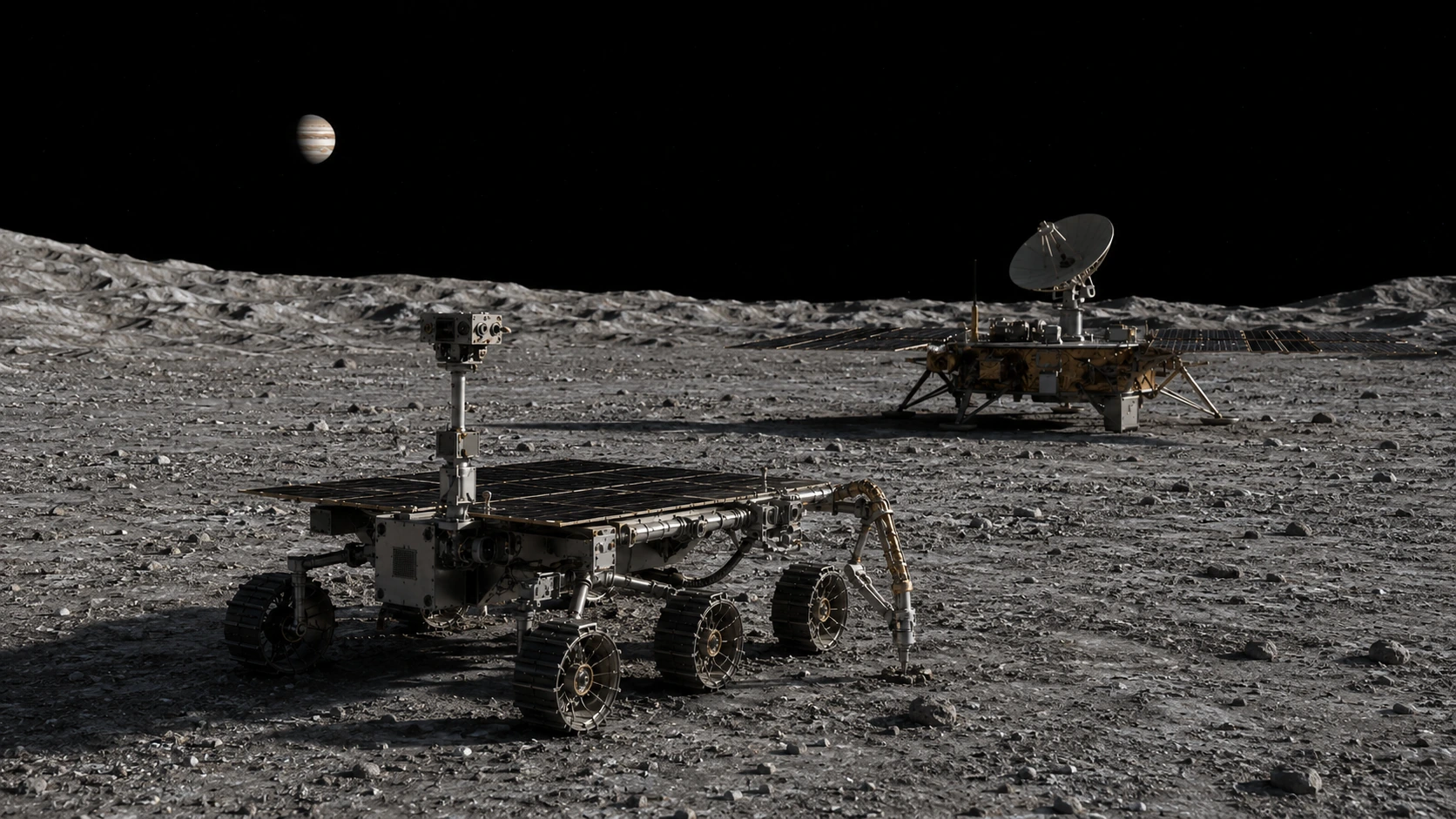
CALLISTO SURFACE / ROBOTIC ICE SCIENCE
A proposed lander and rover mission to study Callisto surface material and investigate shallow ice sampling.
Callisto Rover and Ice Extractor
The concept combines a cruise stage, a lander and a six-wheel rover. After landing, the rover would deploy down a ramp and communicate through the lander. Both vehicles could carry instruments, with the rover focused on close observations and sampling. Landing design and long-term surface survival remain open questions.
Preliminary mission architectureCURRENT STUDY
MISSION PROFILE
The sequence is a mission concept. Timings and performance targets require trajectory and system analysis.
The carrier would establish the required approach to Callisto and deliver the landing system to a selected site.
Following touchdown, the lander would deploy its power and communications equipment and check surface conditions.
The rover would descend the deployment ramp and check mobility and communications near the lander.
The proposed Autonomous Roving System would combine stereo imaging with terrain assessment and route planning. A speed of 1 m/s is an upper design objective rather than a tested limit.
A shallow corer is proposed to obtain ice-bearing material for composition measurements. The lander could continue stationary observations.
If communications failed, the rover would attempt an energy-limited recovery sequence before entering a protective state. The sequence requires testing.
SPACECRAFT ARCHITECTURE
These systems describe the proposed design and the work needed to assess it.
The Autonomous Roving System would require training and verification before deployment. Fixed safety limits would constrain onboard navigation decisions.
The current recovery concept would stop the rover and attempt to retrace a previously accepted route. A higher-power beacon after 18 hours is an unvalidated timing assumption.
A further 18-hour period is proposed before a final data-transmission attempt and low-power state. Battery capacity and mission safety must determine the final timing.
Sunlight at Jupiter is roughly one twenty-fifth of that at Earth. Array area, energy storage and survival through darkness would be major design requirements.
Callisto lies outside the most intense inner Jovian radiation regions. Electronics and instruments would still need environmental qualification and appropriate protection.
Candidate instruments include cameras, spectrometers and a shallow corer. Radar and environmental sensors are also under consideration.
PROPOSED SCIENTIFIC PARTNERSHIP MODEL
A future agreement would define instrument accommodation and integration along with operations and data delivery. Starshot would operate the spacecraft. Development would depend on an agreed scope and sufficient committed funding.
Rover instruments would need agreed power and data limits as well as compatible fields of view or surface-contact requirements.
Lander instruments could use a stationary platform and its Earth communications link within the available power budget.
Partners could propose sampling or observation objectives compatible with the selected site and rover range.
Possible service agreements would define integration work, instrument operations and delivery of the scientific data.
Financial assessment would compare committed funding with the full cost of development and operations. It would also account for launch, integration and insurance alongside contingency and financing costs.
ENGINEERING PRECEDENT
NEXT STEPS
Mission-specific figures are preliminary targets or assumptions. They may change as the trajectory and system designs are developed. The references describe relevant science and prior missions; they do not validate this proposed spacecraft.
Back to Space Systems