Assemble and depart
The departure concept assumes orbital refuelling and a high-energy launch stage. An approximately 8 km/s stage velocity increment is an assumption requiring vehicle and mission analysis.
 STARSHOT AEROSPACEContact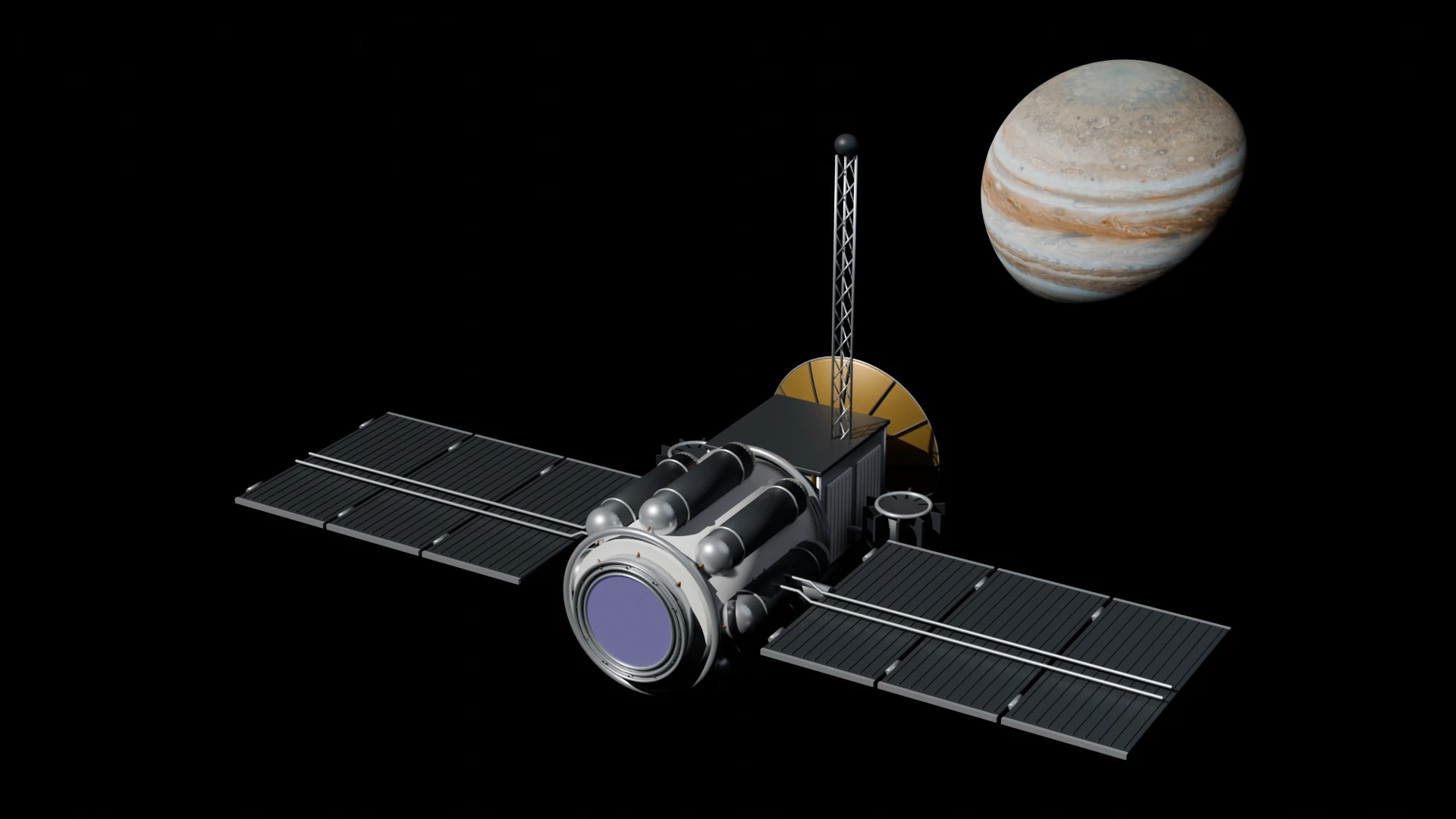
INTERSTELLAR SPACE / LONG-DURATION OBSERVATORY
A long-duration probe concept for studying the heliosphere and the local interstellar medium beyond it.
Fast Interstellar and Heliosphere Probe
The study combines a high-energy Earth departure with a Jupiter gravity assist and a separable nuclear-electric propulsion stage. It targets a final Sun-relative speed near 60 km/s, equivalent to roughly 12.7 astronomical units per year. This is a design objective. Achievability depends on the trajectory and a consistent mass, power and propulsion model.
Preliminary concept; propulsion feasibility unresolvedMISSION VISUALISATION
Visualisations of the proposed spacecraft during encounter, powered departure and independent cruise.
Blender concept renders. Jupiter map: NASA/JPL/Space Science Institute.
The concept uses electric propulsion after a Jupiter encounter to increase the departure speed.
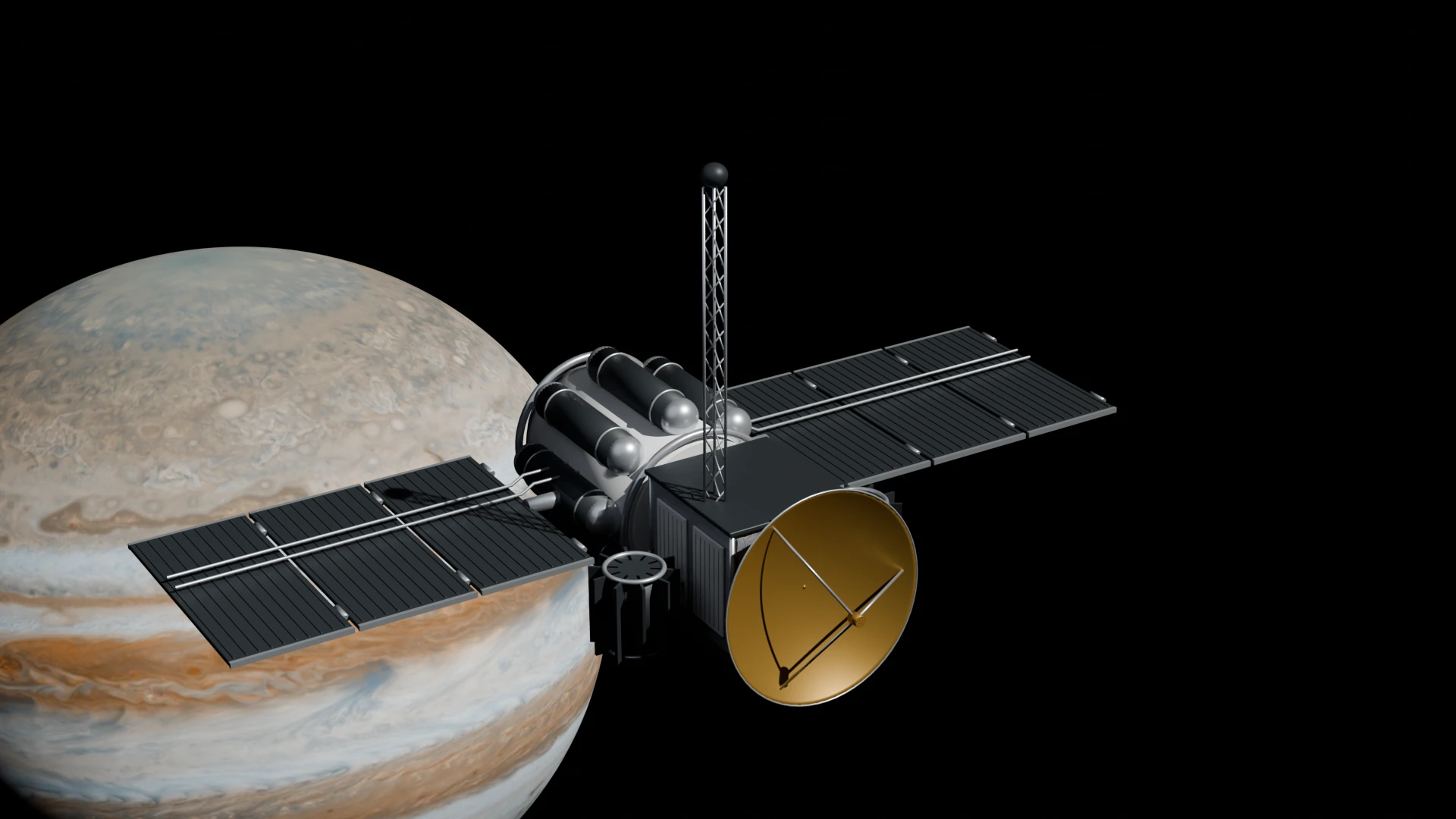
A proposed Jupiter flyby would change the trajectory and provide an opportunity for planetary observations.
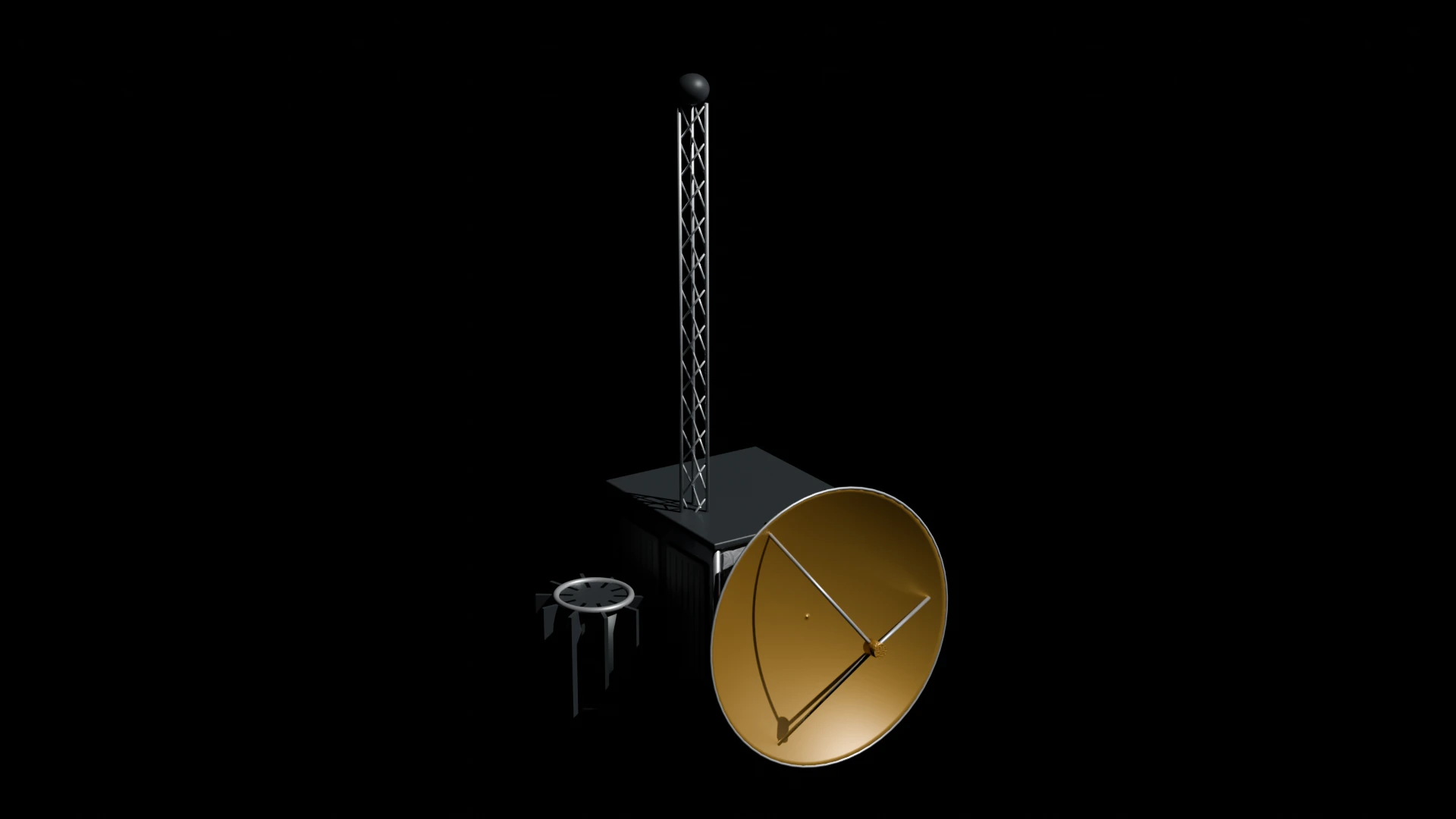
The separated science probe would continue towards the heliopause and the interstellar medium.
CURRENT STUDY
MISSION PROFILE
The sequence is a mission concept. Timings and performance targets require trajectory and system analysis.
The departure concept assumes orbital refuelling and a high-energy launch stage. An approximately 8 km/s stage velocity increment is an assumption requiring vehicle and mission analysis.
The cruise would target a Jupiter gravity assist with suitable clearance from atmospheric and radiation hazards.
A nuclear-electric stage in the approximately 25 kW class is proposed for a multi-year ion-thrust campaign. Reactor mass, heat rejection and thruster efficiency would determine its performance.
The propulsion stage would separate at a planned point after completing its useful thrust campaign. The science probe would then continue independently.
Instruments would measure fields, plasma and particles across the outer heliosphere and beyond the heliopause, where solar wind gives way to the interstellar medium.
A long-duration operating plan would reduce instrument activity as power declines. Component life and communications performance would constrain the useful mission duration.
SPACECRAFT ARCHITECTURE
These systems describe the proposed design and the work needed to assess it.
The candidate stage combines ion thrusters with approximately 1.5 tonnes of xenon and a nuclear-electric power system. Its mass and achievable velocity change remain unresolved.
The science probe is provisionally in the one-tonne class after stage separation. This allocation must include instruments, communications and long-life power equipment.
Multiple radioisotope units and interconnected electrical sections are being considered to limit the effects of individual failures.
Candidate pointing hardware includes reaction wheels, star trackers and small thrusters. Their lifetime and momentum-management needs require analysis.
The proposed payload would study magnetic fields, plasma and energetic particles alongside dust and neutral atoms. Additional astronomy instruments remain options.
A high-gain antenna and onboard storage would support data return as distance increases. Antenna size, transmit power and Earth receiving capacity would set the data rate.
PROPOSED SCIENTIFIC PARTNERSHIP MODEL
A future agreement would define instrument accommodation and integration along with operations and data delivery. Starshot would operate the spacecraft. Development would depend on an agreed scope and sufficient committed funding.
Long-life instruments could be proposed by teams studying heliophysics, planetary science and the interstellar environment.
Observation campaigns would need to fit the departure trajectory and the spacecraft pointing and power limits.
Institutional support could fund instrument operations and long-term archiving of calibrated measurements.
Agencies, universities and foundations could support defined elements of a staged development programme.
Financial assessment would compare committed funding with the full cost of development and operations. It would also account for launch, integration and insurance alongside contingency and financing costs.
ENGINEERING PRECEDENT
NEXT STEPS
Mission-specific figures are preliminary targets or assumptions. They may change as the trajectory and system designs are developed. The references describe relevant science and prior missions; they do not validate this proposed spacecraft.
Back to Space Systems